
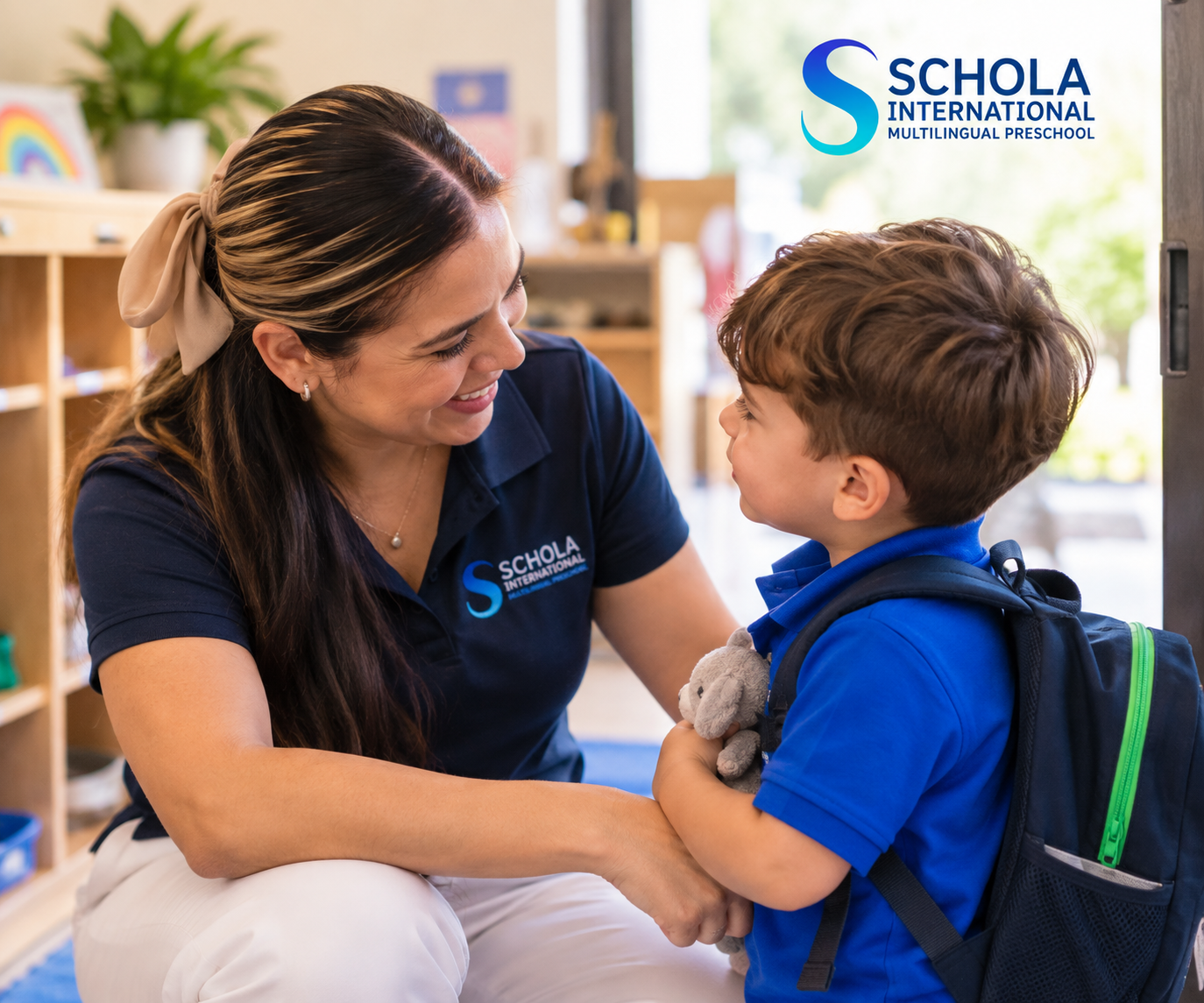
Every child is different. Every transition is different. And every child deserves the time, patience, and support they need to feel safe in a new environment.
At Schola International, we understand that starting preschool is a very important milestone—not only for children, but for their families as well. For some children, it may be their first experience spending several hours away from their parents. They are entering a new environment filled with new faces, new sounds, new routines, new spaces, and new expectations.
That is why we place so much importance on what we call our Vinculation Period: a thoughtful transition period designed to help each child gradually develop trust, familiarity, and a sense of belonging at Schola International.
Every Child Has Their Own Timeline
There is no single formula for starting preschool.
One child may walk into the classroom on the first morning excited and ready to explore. Another child may need several days—or longer—to feel comfortable separating from Mom, Dad, or another trusted caregiver.
Both experiences are normal.
At Schola International, we do not expect every child to adapt in exactly the same way or within exactly the same amount of time. We observe the individual child and respond to their emotional needs.
Our goal is not simply for a child to stay at school without crying. Our goal is for the child to develop a genuine sense of safety, trust, connection, and belonging.
We want children to eventually walk through our doors and understand:
“I know this place. I know these teachers. I know what happens here. I am safe here. This is my school.”
Why Starting Preschool Can Be Difficult
- Young children find security in what is familiar.
- Home, parents, grandparents, siblings, favorite toys, familiar routines, and familiar voices represent their comfort zone. When a child begins preschool, many of those familiar things suddenly change.
- Even when preschool is a wonderful, loving environment, the child does not know that yet.
- Trust takes time.
- Crying during separation can therefore be a natural part of the transition. It does not necessarily mean that the child dislikes school or is having a negative experience. It may simply be the child’s way of expressing:
“This is new. I miss you. I am still learning that I am safe here.”
Our responsibility as educators is to respond with patience, affection, consistency, observation, and reassurance.
Building a Special Connection With a Teacher
During the Vinculation Period, we place special importance on helping the child establish a connection with a trusted teacher.
- Whenever possible, the child will spend significant time with a familiar teacher who can become an emotional point of reference during the transition.
- That teacher can accompany the child while exploring the school, introduce different areas and routines, encourage participation without unnecessary pressure, and provide reassurance when the child is feeling uncertain.
- Little by little, the child begins to associate the teacher with safety and predictability.
- From that secure connection, the child’s world at school begins to expand.
Discovering Schola International at Their Own Pace
Our Vinculation Period is also about exploration.
- Rather than expecting a new child to immediately understand the entire routine, we help them become familiar with the school gradually.
- They may walk around with a teacher and discover the classroom, learning materials, outdoor spaces, play areas, bathrooms, meal and snack routines, rest areas, and other parts of the school.
- We want them to see, touch, explore, observe, and become familiar with their surroundings.
Every positive experience sends an important message:
“This place is becoming familiar to me.”
Over time, unfamiliar spaces become favorite spaces. New teachers become trusted adults. Other children become classmates and friends. Activities that once felt unfamiliar become part of a predictable daily routine.
Crying Is Not Failure
One of the most difficult moments for many parents is leaving while their child is crying.
- We understand how emotional this can be.
- Parents may leave wondering, “Did I do the right thing?” or “Is my child okay without me?”
- At Schola International, we want families to know that emotions are welcome. We do not view crying as bad behavior, and we do not measure a successful transition by the absence of tears.
- Young children are learning how to understand and regulate very big emotions.
- Our role is to stay close, acknowledge those feelings, provide reassurance, redirect when appropriate, and help the child discover that they can feel sad about saying goodbye and still be safe, cared for, and eventually enjoy their day.
With consistency, many children begin to understand an extremely important pattern:
- My family leaves, I have my school day, and my family comes back.
That predictability helps build trust.
Parents Are an Important Part of the Process
The transition to preschool is not only happening for the child. Parents are experiencing a transition too.
- Sometimes the first goodbye is harder for Mom or Dad than expected—and that is understandable.
- Children are also very sensitive to the emotions of the adults they trust. When parents communicate confidence, warmth, and excitement about school, they can help their child understand that this new experience is safe.
A loving and confident goodbye can communicate:
“I love you. I trust your teachers. You are safe. I will come back. Now you can enjoy your day.”
Consistency is also important. Establishing a predictable goodbye routine can help the child understand what to expect each morning.
The goal is not to ignore a child’s emotions. It is to acknowledge those emotions while also communicating confidence in their ability to experience this new adventure.
From Uncertainty to Belonging
One of the most beautiful parts of early childhood education is watching this transformation happen.
- A child who once needed to hold a teacher’s hand while entering the classroom may eventually run inside excited to see friends.
- A child who initially observed activities from a distance may begin participating enthusiastically.
- A child who cried during goodbye may eventually turn around, wave, and say, “Bye, Mommy!”
- These moments may seem small, but they represent enormous emotional growth.
- The child is developing confidence, independence, relationships, communication skills, and a sense of belonging.
Preschool Is About Much More Than Academics
At Schola International, we believe early childhood education is about educating the whole child.
- Children learn through relationships, movement, play, exploration, conversation, creativity, observation, problem-solving, and meaningful interactions with other children and adults.
- Preschool gives young children opportunities to practice sharing space with others, communicating their needs, developing friendships, solving small conflicts, becoming more independent, participating in group experiences, following routines, discovering new interests, and developing confidence.
- When children feel emotionally secure, they are more prepared to explore and learn.
Connection comes before learning. Trust comes before independence. Belonging creates the foundation for growth.
We Do Not Rush Childhood
At Schola International, we understand that young children are still developing emotionally, socially, physically, and cognitively.
- We don’t expect them to behave like adults.
- We don’t expect every child to respond in the same way.
- And we don’t expect meaningful relationships to happen instantly.
- Instead, we observe, accompany, encourage, and give children opportunities to develop confidence.
- Some children may need a shorter transition. Others may need additional time and support. Our team works with families to understand each child’s individual experience and determine how we can best support them.
Communication Between School and Family Matters
A successful transition works best when families and educators communicate openly.
- Parents know their children deeply. Teachers observe children within the school environment. When we bring those perspectives together, we can better understand what a child needs.
- We encourage families to share information that may help us support their child, including routines, interests, comforting strategies, important changes at home, previous childcare experiences, and anything else that may affect the transition.
- Likewise, our educators observe how the child is developing relationships, participating in activities, navigating routines, and becoming more comfortable within the school environment.
We are partners in the child’s journey.
When Schola Becomes Their School
The ultimate purpose of our Vinculation Period is simple:
- We want every child to feel that they belong.
- Schola International should not simply be the place where a parent leaves their child each morning. We want it to become a community where the child feels known, valued, protected, encouraged, and excited to learn.
- We want children to build meaningful relationships with their teachers.
- We want them to recognize their classmates.
- We want them to know where their favorite materials are.
- We want them to have favorite activities, songs, stories, and spaces.
- We want them to laugh, explore, create, communicate, make mistakes, try again, develop friendships, become more independent, and discover just how capable they are.
And most importantly, we want them to feel safe enough to be themselves.
At Schola International, Every Beginning Matters
The first days of preschool are the beginning of an important chapter in a child’s life.
That is why at Schola International, we care deeply about the transition process. We don’t see it as something that simply needs to be “completed.” We see it as the beginning of a relationship between the child, their family, their teachers, and our school community.
- We understand the tears.
- We celebrate the little victories.
- We respect individual timelines.
- We communicate with families.
- We build relationships.
And day by day, we help children move from uncertainty to familiarity, from familiarity to confidence, and from confidence to belonging.
Because when a young child feels safe, loved, respected, and connected, something beautiful happens:
They are ready to explore.
They are ready to learn.
They are ready to grow.
They are ready to bloom.
Welcome to Schola International—where every child’s journey begins with connection.