At Schola International, meeting the minimum standard is important—but our vision for early childhood education goes beyond minimum requirements.
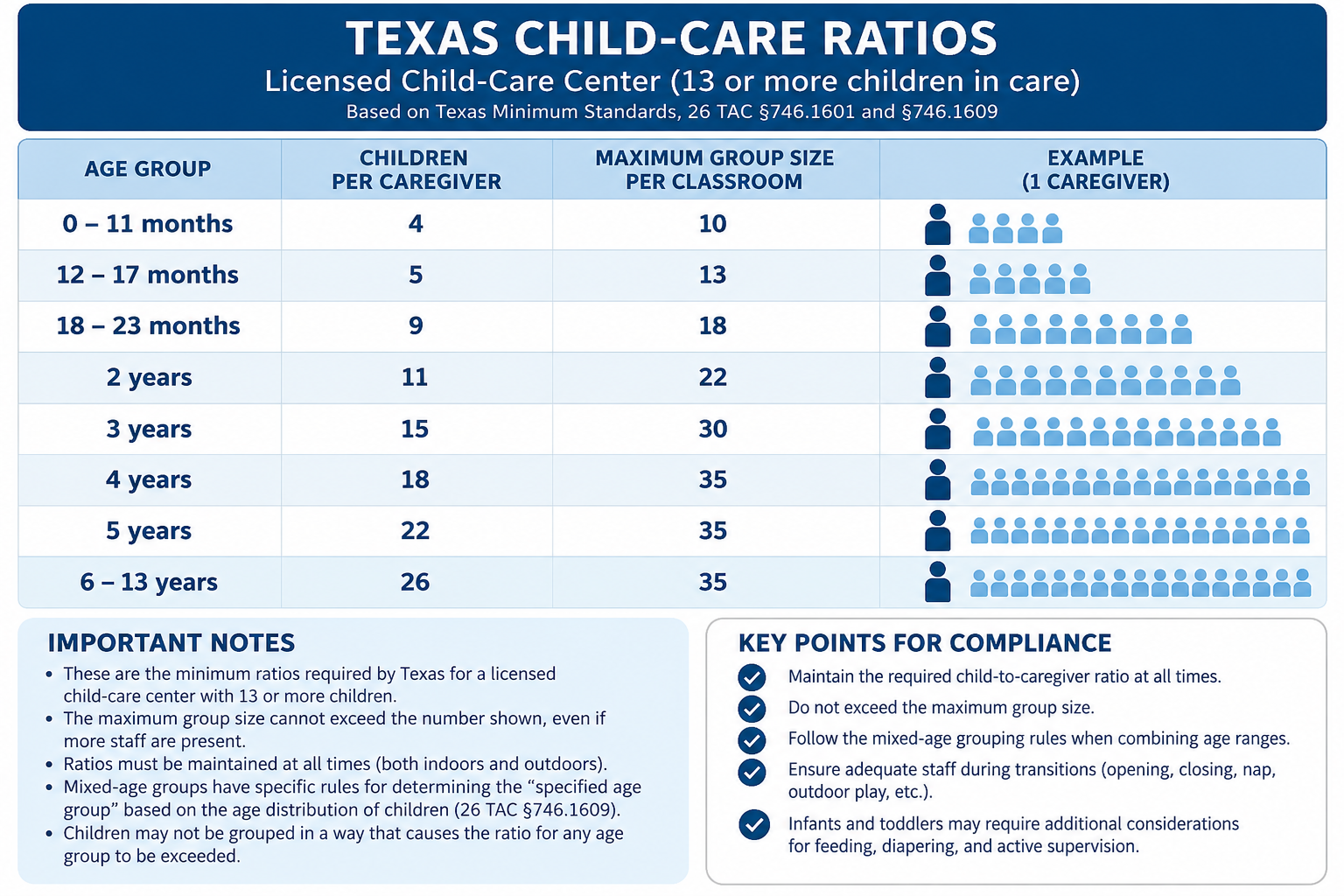
Texas establishes specific child-to-caregiver ratios for licensed child-care centers. These standards define the maximum number of children one caregiver may supervise based on the children’s ages.
For example, Texas standards allow one caregiver to supervise up to:
- 9 children ages 18–23 months
- 11 children who are 2 years old
- 15 children who are 3 years old
- 18 children who are 4 years old
- 22 children who are 5 years old
Source: Texas Health and Human Services, Minimum Standards for Child-Care Centers, §746.1601.
At Schola International, we respect Texas licensing standards, but we intentionally strive for lower teacher-to-child ratios and smaller learning groups whenever possible.
Why?
Because young children need more than supervision.
They need adults who know them.
A smaller group gives our teachers greater opportunities to observe each child’s development, recognize changes in behavior and emotions, understand individual interests, and identify areas where a child may need additional encouragement or support.
Texas regulations themselves recognize the importance of individual needs. When assigning caregivers, child-care centers must consider both the caregiver’s skills and the needs of the individual children and the group.
This philosophy is especially important during the preschool years, when children are developing language, independence, confidence, emotional regulation, social skills, curiosity, and their understanding of the world around them.
A Lower Ratio Means More Opportunities for Connection
For us, a low ratio is not simply a number we advertise.
It means a teacher has more opportunities to notice:
“She is unusually quiet today.”
“He is becoming more confident communicating in Spanish.”
“She is ready for a more challenging activity.”
“He needs a little extra support joining the group.”
“Look how much progress she has made!”
Those small observations matter.
They help our teachers create meaningful learning experiences and communicate with families about how their child is learning, growing, and blooming.
Parents Deserve to Know Their Child Is Known
When parents leave their young child at school, they are trusting us with someone incredibly important to them.
We want our families to feel that their child isn’t simply another name on an attendance list.
We know your child.
We see your child.
We listen to your child.
We celebrate your child’s progress.
And we care about who your child is becoming.
That is one of the reasons Schola International believes in maintaining smaller groups and low teacher-to-child ratios whenever possible.
Texas establishes the standards we must meet. At Schola International, our goal is to build upon those standards with an environment centered on relationships, individualized attention, meaningful observation, and genuine care.
Because during these first years of life, every interaction matters.
Small Groups. Meaningful Relationships. Individual Attention.
At Schola International, we believe children learn best when they feel safe, seen, understood, and valued.
We don’t choose lower ratios because we have to. We choose them because we believe your child deserves to be known.
Schola International — A multilingual, international early-learning community where every child has space to learn, explore, connect, and bloom.
Texas reference: Texas Health and Human Services Commission, Minimum Standards for Child-Care Centers, Chapter 746, including §§746.1507 and 746.1601. Texas standards should always be consulted directly for applicable ratio, group-size, mixed-age, and other licensing requirements.