
The STEAM Science Project is an innovative educational initiative that combines Science, Technology, Engineering, Arts, and Mathematics (STEAM) to inspire creativity, critical thinking, and problem-solving skills. Through hands-on activities, experiments, and collaborative projects, students explore real-world challenges while developing the knowledge and skills needed for the future. Our goal is to foster curiosity, innovation, and a lifelong passion for learning in a dynamic and engaging environment.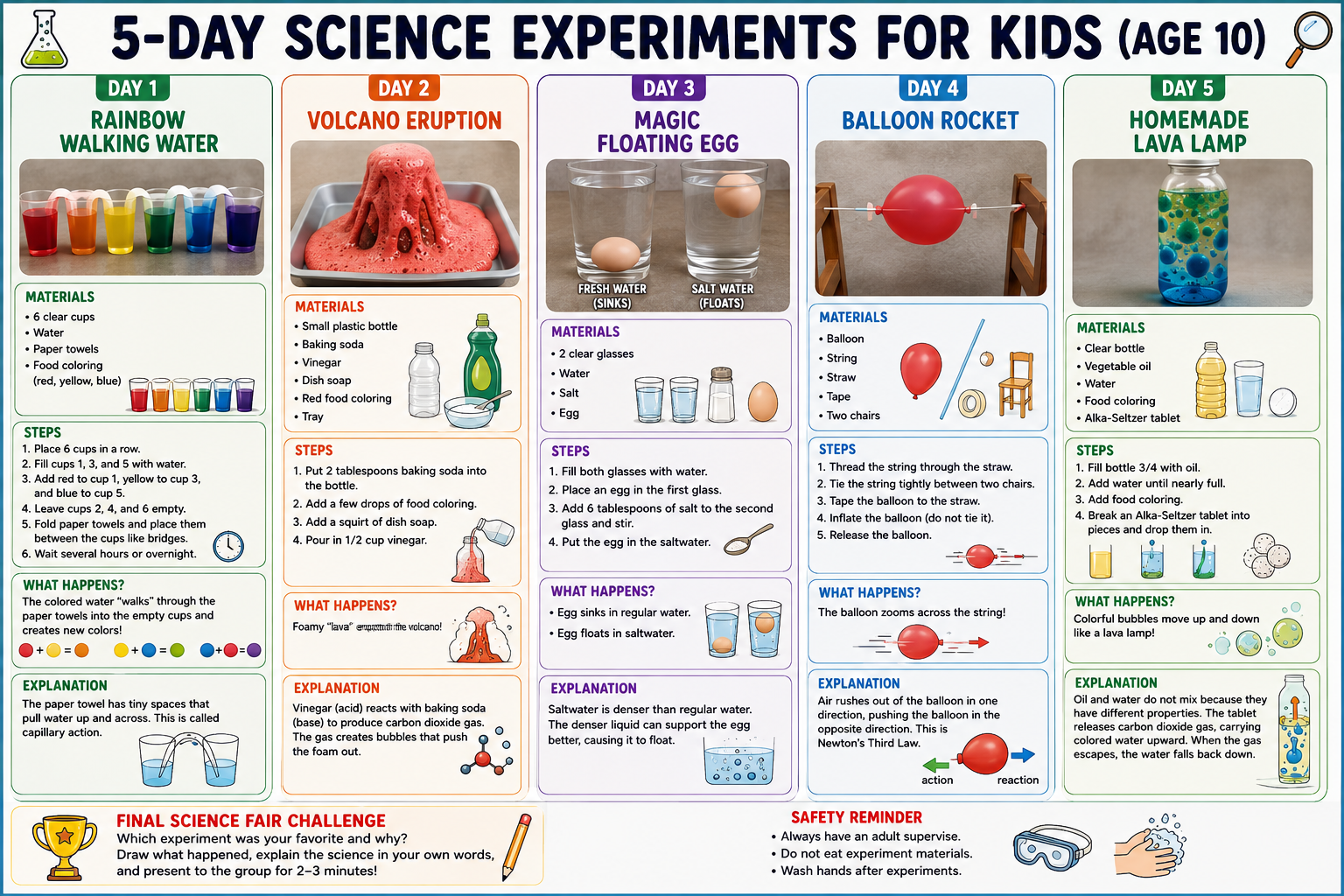
1. Rainbow Walking Water
What happens?
The colored water moves through the paper towels and fills the empty cups. New colors appear where the colors mix.
Why does it happen?
Water can travel through tiny spaces in the paper towel. This is called capillary action. The water moves up the towel and into the next cup.
Science behind it:
- Capillary action
- Water movement
- Color mixing
Example:
Plants use capillary action to move water from their roots to their leaves.
2. Volcano Eruption
What happens?
A bubbly “lava” erupts from the bottle and flows over the sides.
Why does it happen?
When vinegar and baking soda mix, they create a gas called carbon dioxide (CO₂). The gas forms bubbles that push the foam out of the bottle.
Science behind it:
- Chemical reactions
- Acids and bases
- Gas production
Example:
Real volcanoes release gases during eruptions, although they do not use baking soda and vinegar!.
3. Magic Floating Egg
What happens?
The egg sinks in regular water but floats in saltwater.
Why does it happen?
Saltwater is denser than regular water. The denser water pushes up on the egg more strongly, helping it float.
Science behind it:
- Density
- Buoyancy
- Floating and sinking
Example:
People float more easily in the Dead Sea because it contains a lot of salt.
4. Balloon Rocket
What happens?
The balloon shoots across the string when the air is released.
Why does it happen?
As air rushes out the back of the balloon, it pushes the balloon forward. This is called Newton’s Third Law of Motion:
For every action, there is an equal and opposite reaction.
Science behind it:
- Forces
- Motion
- Newton’s Laws
Example:
Real rockets work the same way when hot gases shoot out of the engines.
5.Homemade Lava Lamp
What happens?
Colorful bubbles move up and down inside the bottle.
Why does it happen?
Oil and water do not mix. The Alka-Seltzer tablet releases carbon dioxide gas. The gas sticks to drops of colored water and lifts them upward. When the gas escapes, the drops sink back down.
Science behind it:
- Density
- Chemical reactions
- Gas bubbles
Example:
Scientists study how different liquids interact because many substances in nature do not mix.
1. Crystal Growing
What Happens?
Over several days, beautiful crystals begin to form and grow on the string.
Why Does It Happen?
When you dissolve Epsom salt in hot water, you create a saturated solution, meaning the water holds as much salt as possible.
As the water slowly cools and evaporates:
- The water can no longer hold all the dissolved salt.
- The extra salt particles stick together.
- These particles arrange themselves into a repeating pattern called a crystal lattice.
The crystal acts like a “seed” that attracts more particles, making the crystal grow larger.
Scientific Concepts
✅ Saturated solutions
✅ Evaporation
✅ Crystal formation (Crystallization)
Real-World Connection
Scientists use crystallization to make medicines, sugar, and even some gemstones.
2. Lemon Battery
What Happens?
The lemon creates a small electric current that can power a tiny LED or digital clock.
Why Does It Happen?
The lemon juice contains citric acid, which acts as an electrolyte.
The zinc nail and copper coin are different metals:
- Zinc wants to lose electrons.
- Copper attracts electrons.
Electrons move from zinc to copper through the wire, creating an electrical current.
This movement of electrons is electricity!
Scientific Concepts
✅ Chemical energy
✅ Electricity
✅ Electrons
✅ Circuits
Real-World Connection
All batteries work using chemical reactions that produce electricity.
3. Density Tower
What Happens?
The liquids form colorful layers instead of mixing together.
Why Does It Happen?
Each liquid has a different density.
Density means how much mass is packed into a certain space.
Examples:
- Honey is very dense.
- Corn syrup is slightly less dense.
- Water is less dense.
- Oil is even less dense.
- Rubbing alcohol is the least dense.
The densest liquids sink to the bottom while the least dense float on top.
Scientific Concepts
✅ Density
✅ Mass and volume
✅ Properties of matter
Real-World Connection
Oil spills float on oceans because oil is less dense than water.
4. Elephant Toothpaste
What Happens?
A huge amount of foam quickly erupts from the bottle.
Why Does It Happen?
Hydrogen peroxide naturally breaks down into:
Water + Oxygen Gas
The yeast contains an enzyme called catalase.
Catalase speeds up the reaction dramatically.
The oxygen gas gets trapped inside soap bubbles, creating lots of foam that shoots out of the bottle.
Scientific Concepts
✅ Enzymes
✅ Chemical reactions
✅ Catalysts
✅ Gas production
Real-World Connection
Catalase is found in your body and helps break down harmful hydrogen peroxide produced by your cells.
5. Homemade pH Indicator
What Happens?
The cabbage juice changes color when mixed with different liquids.
Why Does It Happen?
Red cabbage contains natural pigments called anthocyanins.
Anthocyanins react differently depending on whether a liquid is:
- Acidic
- Neutral
- Basic (alkaline)
Color Changes
| Substance | pH Type | Color |
|---|---|---|
| Lemon juice | Acid | Pink/Red |
| Vinegar | Acid | Pink |
| Water | Neutral | Purple |
| Baking soda solution | Base | Blue |
| Soap solution | Stronger Base | Green |
Scientific Concepts
✅ Acids and bases
✅ pH scale
✅ Chemical indicators
Real-World Connection
Scientists use indicators to test water quality, soil, food products, and swimming pools.
Scientist Challenge Questions
After each experiment, ask students:
Crystal Growing
- Why do crystals grow slowly?
- What would happen if the water evaporated faster?
Lemon Battery
- Why do we need two different metals?
- How could we make the battery stronger?
Density Tower
- Why don’t all liquids mix together?
- Which liquid do you think is most dense?
Elephant Toothpaste
- What role does yeast play?
- What gas is produced?
pH Indicator
- Which household liquids are acidic?
- Which are basic?
- Why do the colors change?
.